Text from this review not to be used without authorization.
Please contact:

Peter Kleist is taking a break from his studies in America to spend some time with relations in Austria. He is curious about the legend of Baron Otto von Kleist, a distant ancestor of his, who ruthlessly ruled the region and killed and tortured thousands. Making friends with castle restorer Eva Arnold (Elke Sommer), Peter reveals that he has an original parchment with an invocation that will raise the Baron back to life. Along with Eva, he heads to the castle on a stormy night to recite the incantation and unleashes the evil Baron, however, when the parchment burns in a fire, they lose the reverse spell and there seems to be no way to return the Baron to hell...
If the 1960s were marked by subtlety and suggestion, the 1970s was the decade of excess - the giallo genre would give Italian cinema a free license for some of the most sex and blood filled movies yet produced. Gothic horror rolled along in the background, gradually getting gorier and sexier with films like Lady Frankenstein (1972) packed full of nudity and violence. Mario Bava has something of a reputation of being a conservative director, but his earlier La Frusta e il Corpo (1963) contained some very overt sadean-sexual themes (that saw even the Italian censorship board baulk) while his more recent giallo entries, particularly Twitch of the Death Nerve (1972) had contained several vivid gory effects, so it is a particular disappointment that his return to the gothic horror genre was rather tame.
The story behind Baron Blood seems to be very similar to the earlier Italian gothic horror The Virgin of Nuremberg (1963) or Bava's own Whip and the Body (1964) with a mystery man killing people in a castle - although while those films managed to build up some mystery over the identity of the killer and whether or not they were human or ghostly monster, Baron Blood gives the game away early on with a shot of the Baron rising from the grave. Of course Bava had already made a pure horror film in Black Sunday (1960) that shows us that the monsters are supernatural from the start, but that film thrived with an incredible atmosphere that this simply lacks. In horror movie terms, Baron Blood is more akin to the later American slasher films with the Baron stalking and chasing the main characters, while killing off conveniently placed minor figures for no particular reason. The climax is nothing special and the plot is full of holes.
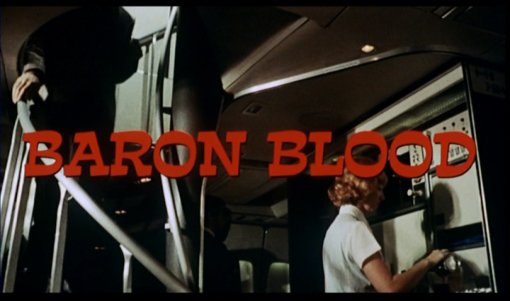
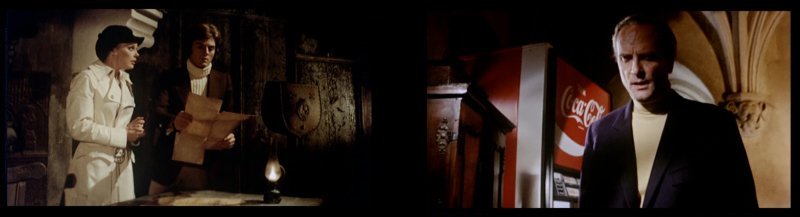
Compared to his earlier gothic horrors, Bava's direction here seems very poor - gone are his wonderful lighting effects, replaced by some awkward and often dizzying hand-held camerawork. There are some nice camera-angles and the Baron's chase through a foggy street looks good, although generally the film is not very scary, a cheap fake scare early on destroys any tension. The production design starts off well, with the Baron Blood credit playing over shots of an airliner and the wonderful juxtaposition of a Coke machine in the middle of the castle but it soon gives way to a standard 'gothic castle' ambience. Composer Stelvio Cipriani gives a rather unimpressive score that does little to lift the film.

One of Hollywood's biggest names in the 1940s, Joseph Cotten took time away from making films and found himself largely forgotten by the moviemakers and reduced to television roles - he did manage to find work in Europe and briefly flirted with horror in the early 1970s, appearing in the afforementioned Lady Frankenstein (1972) and The Abominable Dr. Phibes (1972) - however, he is rather miscast here in a role that would have far better suited Vincent Price or Christopher Lee - maybe even Peter Cushing, he just never carries any of the required gravitas. Actress Elke Sommer gets little to do but scream (Bava subsequently used her a lot more effectively in Lisa and the Devil (1973)) and the rest of the cast are rather unimpressive.
The last of Bava's gothic horror films was a dated entry even upon its initial release - lacking the gore and sex of many similar movies of the time - fortunately, the film performed well enough that producer Alfredo Leone let Bava have another shot at a completely self-penned project which became Lisa and the Devil (1973). With some unimpressive direction and a plot that starts well but soon just becomes a typical stalking-monster story, of interest to Bava fans but not recommended on its own merits.

| Anyone famous in it? | Joseph Cotten - American actor famous for his lead role in The Third Man (1949). |
| Directed by anyone interesting? | Mario Bava - Often considered to be one of the best European cinema directors he directed a wide range of films, but was most at home in the horror genre on films like Black Sunday (1960). |
| Is it scary? | There are a few atmospheric scenes that might prove scary. |
| Any gore or violence ? | Some bloody deaths. |
| Any sex or nudity? | None |
| Who is it for? | Fans of Bava and gothic horror might enjoy this but it is certainly a lesser entry. |
| Visuals | Original Aspect Ratio - 1.85:1 anamorphic widescreen. Colour. The print is good with strong colours, although it is slightly soft with a heavy layer of grain - minimal print damage. |
| Audio | German, Italian and English mono. All tracks are strong and the dubbing is decent in all three. |
| Subtitles | German - translation of the Italian track. |
| Extras | The disc includes:
|
| Region | Region 2 (UK, Europe) - PAL |
| Packaging | A standard Amaray case contained within a cardboard slip-cover. |
| Availability | German DVD Release - Title: Baron Blood |
| Other regions? | Available from Anchor Bay in the US as part of the 8 film Mario Bava Collection Vol. 2 with a similarly strong anamorphic print with English audio. Includes a newly recorded audio commentary from Bava expert Tim Lucas. Previously available in the US from Image DVD with a low quality, non-anamorphic print. The Italian release from Raro has more features including English subtitled version of the Castle of Horrors documentary from the E-M-S disc and English subs for the whole film to fit with an Italian soundtrack, as well as the English audio. |
| Cuts? | The film is believed to be uncut. The film was considerably re-edited when shown in the USA, the version shown here is the original European theatrical cut. |