Text from this review not to be used without authorization.
Please contact:

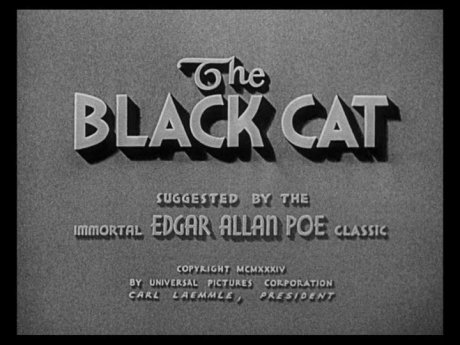
"For the most wild, yet most homely narrative which I am about to pen,
I neither expect nor solicit belief. Mad indeed would I be to expect it,
in a case where my very senses reject their own evidence.
Yet, mad am I not -- and very surely do I not dream.
But to-morrow I die, and to-day I would unburthen my soul".
Edgar Allan Poe - The Black Cat
A young American couple, Peter Alison (David Manners) and his wife Joan are travelling on their honeymoon in Eastern Europe, on the train they encounter the mysterious Dr. Vitus Werdegast (Bela Lugosi); he is on his way to visit the home of an 'old friend', Hjalmar Poelzig (Boris Karloff). Involved in a bus accident, Joan is injured and Vitus takes her and Peter to stay at Poelzig's house. Poelzig and Werdegast have a long history and have designs to kill each other, but are distracted by the presence of the Alison family. It appears that Poelzig has designs on Joan and has no desire to let her go... he has more sinister plans.
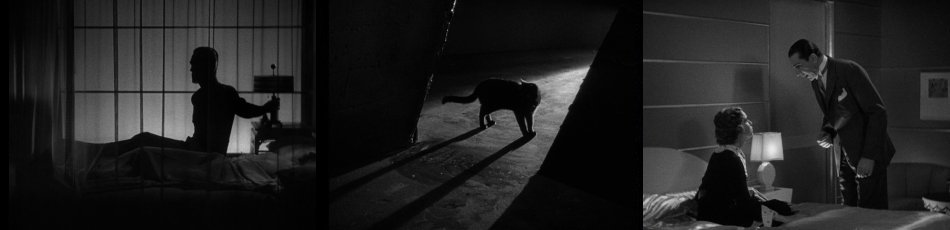
The Black Cat was Universal Film’s second excursion of the 1930s into the works of Edgar Allan Poe. Like Murders in the Rue Morgue (1932) and the later The Raven (1935), the link between Poe’s work and the end film is minimal – indeed here only Werdegast's irrational fear of cats links the film with the story of its title. Originally to have been much stronger in its violent themes, test-audience outrage meant reshoots were in order and a number of changes were made to the final picture.
The story boasts a solid opening 45 minutes of intrigue and character build-up - from the moment we meet Lugosi's Werdegast it is as though the characters have entered a nightmare (a theme that was sadly not exploited in this film), the introduction of Poelzig only further compounds the mystery as both men act courteously yet threateningly to each other. The two play a game of chess over Joan, with Poelzig determined to keep her in his house if he should win - sadly though this game is never really shown in any detail and could have provided a lot of tension. The film really starts to take a downturn when the local police arrive to investigate the bus crash, their comedy relief destroying the eerie, isolated atmosphere that the film had boasted up to the point. In the last twenty minutes the pace picks up rapidly, much to the detriment of the film - suddenly there is a Satanic ritual and just as quickly it ends for no reason; Joan bumps into Werdegast's daughter and suddenly she is dead, for no obvious reason. The ending comes as a real cop-out considering the tension built up and the comic-relief epilogue just breaks the camel's back.
On the plus side, direction is decent and the set designs are outstanding. Although the build-up suggests that Poelzig will be living in a gothic castle, he in fact inhabits an ultra-modern (1930s) house with sliding metal doors and large windows. This helps to keep the film away from the normal horror clichés and gives it an interesing new edge. Although the camerawork is quite standard for the most part, there are a few standout scenes. In one, the camera moves along a corridor around the house as Karloff continues to talk in the background - while Poelzig's introductions, first in silhouette and then coming through a door that he does not seem to open (see: The Mummy (1932)), look very impressive. The music is a standard Universal affair, with the usual hints of Bach's Toccata and Fugue in D Minor on the organ.
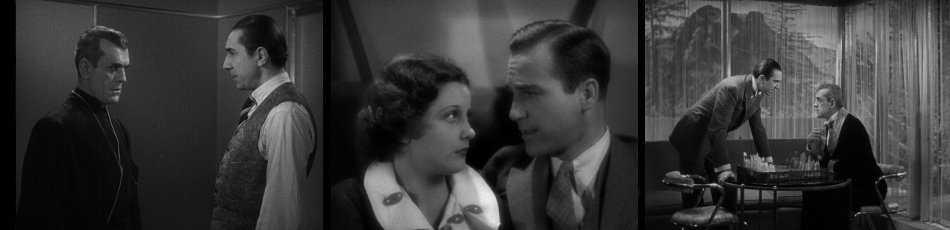
Karloff and Lugosi are together on screen for the first time and they don't disappoint. Both actors seem to be trying to outdo each other with creepy voices and look very impressive when switching from threatening each other to being hospitable to Peter when he bumbles into scene. David Manners, as Peter, gives a typically meek performance although one well suited to the role.
The Black Cat is the start of a very good film but sadly suffers from a rushed and confused finalé. For fans of Karloff and Lugosi who enjoy their distinctive style, this film is a dream come true and finds them both at the peak of their acting prowess. Recommended to fans of the duo, or of Universal Horror pictures - this one of their best entries outside of the well-known monster pictures.
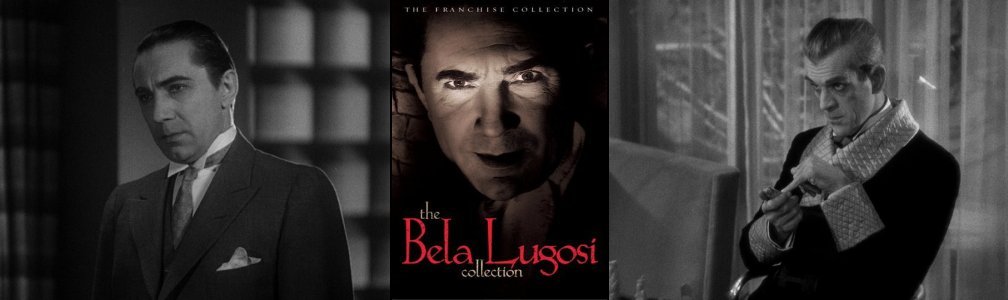
| Anyone famous in it? | Bela Lugosi - the most famous Hungarian export, best known for his leading role in Dracula (1931) Boris Karloff - a legend of horror cinema, and best known for his defining role in Frankenstein (1931) David Manners - Universal's 'meek man in danger', played Harker in Dracula (1931). |
| Directed by anyone interesting? | Edgar G. Ulmer - known as the 'miracle man of poverty row', he was able to shoot dramatic films with minimum budget including the Film Noir Detour (1945) and John Carradine horror Bluebeard (1944). |
| Any gore or violence ? | A little blood. |
| Any sex or nudity? | None |
| Who is it for? | Lugosi and Karloff fans should enjoy, as should Universal Horror devotees. |
| Visuals | Original Aspect Ratio - 1.33:1 fullscreen. Black and White. The print quality is strong, few speckles some grain. |
| Audio | English mono. Very strong and clear. |
| Subtitles | English HOH, French and Spanish. |
| Extras | None. |
| Region | Region 2 (UK, Europe) - PAL |
| Availability | Only avaliable in The Bela Lugosi Collection boxset. |
| Other regions? | Released as a single disc in the UK. Some budget releases with lower quality prints. |
| Cuts? | Believed to be fully uncut. English language print |