Text from this review not to be used without authorization.
Please contact:

William Marshall stars in AIP's classic blaxploitation vampire film. Optimum UK R2 DVD
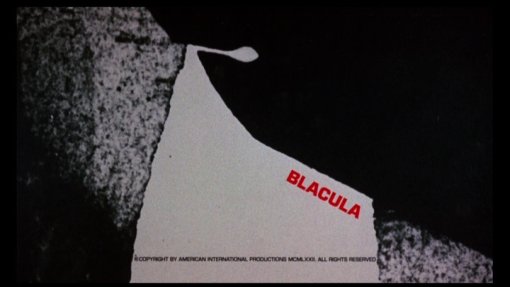
19th Century Transylvania - the African Prince Mamuwalde (William Marshall) has come to appeal to Count Dracula for his signature on a petition to end the slave trade. The meeting goes badly and the vampiric Dracula bites Mamuwalde before locking him in a coffin - dooming him to an eternity of yearning for blood but never being able to find it. Mamuwalde's wife Luva is tied up in the castle and left to die. Two centuries later a pair of Los Angeles antique collectors buy out all of the artefacts from the castle and bring them to the USA. Accidentally bleeding on a coffin, they reawaken Mamuwalde who kills them and sets out into the city. Catching sight of the young woman Tina, he sees her as the reincarnation of his wife, but her friend Dr. Thomas is catching on that something strange is loose in LA...
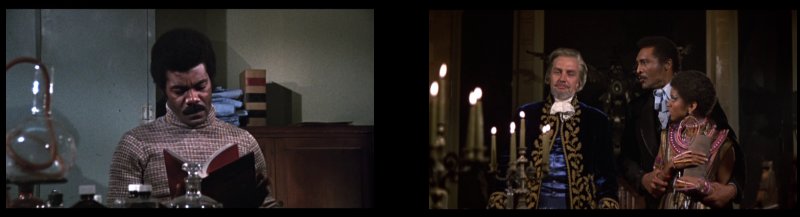
Like many of the 'Blaxploitation' films of the genre's boom in the 1970s, Blacula takes a standard storyline and furnishes a black cast and urban US locations. In this case the story is a rather unoriginal 'Dracula in the Modern Day' tale and most of the twists can be spotted well in advance by horror fans, but fortunately there are enough neat touches to keep the film moving. The idea from the prologue of vampirism being used as a torture is very interesting although sadly not fully explored. More notable is the presentation of the vampire as a romantic creature - a world away from Bram Stoker's repellant villain it is a theme that is particularly strong throughout the film and not just a subplot, leading to the particularly emotive climax. Specifically, Blacula sees the first appearance of the re-incarnated love storyline that had been used sucessfully in Mummy films by both Universal and Hammer and would soon appear in a 'straight' Dracula film Dan Curtis' Dracula (1974) as well as being recycled later in Bram Stoker's Dracula (1992).
Traditional vampire lore is generally ahered to, which does lead to a few plot holes, specifically around the subject of creating vampires. Everyone bitten by a vampire becomes a vampire, but they are generally zombie-like (and often portrayed in the film more like zombies than vampires) whereas Blacula himself, bitten by the real Count Dracula, is verbose and intellegent. A minor curiosity is the change that Blacula undergoes when bloodthirsty, growing lupine facial hair and becoming seemingly uncontrollable, much more akin to scene from a werewolf than vampire movie. Similar to the Hammer Dracula films, Blacula is presented as something of a boogeyman figure, secondary to the main human characters and so spends a lot of time off-screen, although he does at least get more screentime than Christopher Lee received in the Hammer sequels and certainly gets far better dialogue.
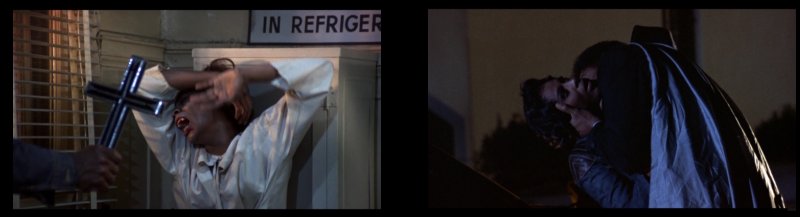
Less a plot hole than simply a lack of detail in the script is the presumably quite massive culture shock experienced by the vampire when he finds himself in modern day Los Angeles, something he seems to shrug off quite easily - the script writers were perhaps trying to avoid the comedy that these scenes would provide, because although the film's title and premise is suggestive of a comedy or spoof production, the film is in fact presented as a relatively serious horror work (with the possible exception of the camp antique collectors at the start who must have been intended to be comedic, even if they are just rather annoying).
In its tone Blacula is very remniscent of AIP's earlier Poe films, or the 1960s Hammer gothic horrors and as such is quite slowly paced and surprisingly conservative - with only a little blood and no nudity at all - a real surprise in a 1970s horror film. However, although it never really tries to be scary, there are a few good jump shocks - something that many of the more traditional gothic horrors often completely ignored. As a 'Blaxplotation' film, Blacula offers nothing particularly new to the plate - all of the lead characters are black but this is never a factor in the storyline, only the 'funky' dialogue of a couple of the characters shows that it was indended for a black cast and most of the parts could have been played by white actors without any changes to the script.
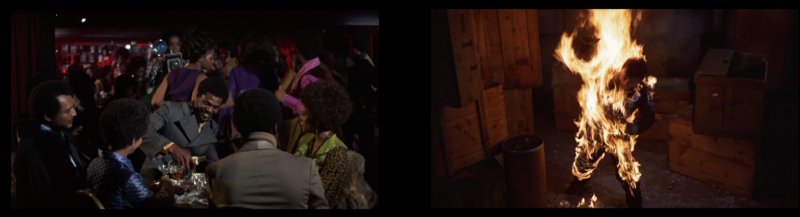
Much like the script, director William Crain's work on the film is traditional and conservative in nature - taking inspiration more from the Terence Fisher school of film making than AIP's own Roger Corman films which often boasted unusual and quite daring camerawork and lighting. However, the production is generally sound with some good looking sets and there is one amazing special effects sequence when a room full of vampires are set ablaze. Unfortunately the vampire/zombies are saddled with some of the most appalling make-up ever used in a film and look like student Hallowe'en revellers rather than the terrifying undead. More effective is the transformation effect as Blacula becomes bat which is carried out with an animation in the same way that Universal did back in their 1940s monster movies, avoiding the cheap rubber bats that plagued several Hammer films. A funky soundtrack helps to remind viewers that this is the 1970s.
Shakesperian stage actor William Marshall is inspired casting in the title role here - he brings a dignity and presence to the film that really helps it to rise above mere exploitation fare and gives the dialogue some real gravitas. Gordon Pinsent (Colossus: The Forbin Project (1970)) and Thalmus Rasulala (Born American (1986)) put in similarly strong turns as the head of police and a doctor (the film's Van Helsing character) while Vonetta McGee (Il Grande silenzio (1968)) plays a dual role as Blacula's wife and her re-incarnation.
Not quite the Blaxploitation romp that the title suggests and with a tone that seems a decade too late, Blacula is an interesting modern-gothic horror film with some good ideas emerging in the script even if the general storyline is nothing too original. While the direction and production are rather conservative, the acting is solid and William Marshall is certainly worth seeing in the title role. Although certainly of interest to Blaxploitation fans, Blacula should also appeal to fans of the 1960s gothic horrors.
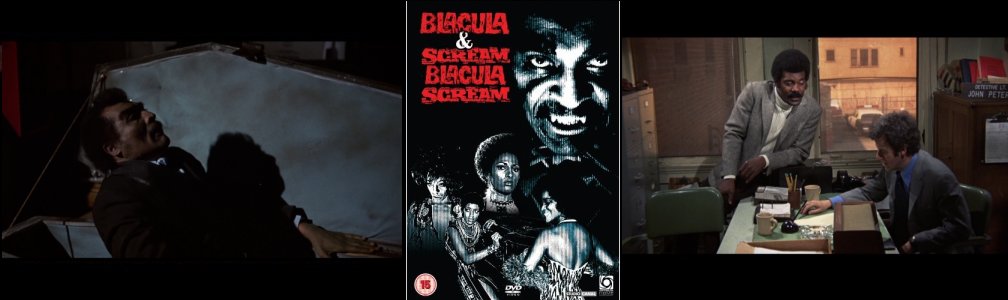
| Anyone famous in it? | William Marshall - an American born actor best known for this role but who later appeared in Othello (1981) |
| Directed by anyone interesting? | William Crain - a little known director who also worked on the Blaxploitation horror Dr. Black, Mr. Hyde (1976) |
| Any gore or violence? | Some blood, nothing gory. |
| Any sex or nudity? | None. |
| Who is it for? | Fans of Blaxploitation will certainly want to see this classic entry, certainly of interest to fans of gothic horror. |
| Visuals | Original Aspect Ratio - 1.85:1 anamorphic widescreen. Colour. Quality is generally strong, some grain and specking but good colours and detail |
| Audio | English mono, sounds fine. |
| Subtitles | None |
| Extras | The disc includes:
|
| Availability | Only available as part of a double-pack with Scream Blacula Scream |
| Region | Region 2 (UK and Europe) - PAL |
| Other regions? | Also available in the US from MGM - includes the trailer, with English, French and Spanish subs. |
| Cuts? | Fully uncut. The print used here is English. |