Text from this review not to be used without authorization.
Please contact:


By the mid-1960s the idea of Italian Westerns had taken off, thanks to the global impact of Sergio Leone's legendary dollars trilogy. However the myriad of spin-off films reeled out by other Italian studios had lacked a particular focus, many of them trying to hide themselves as American productions with American leading casts, Americanised credits and very traditional style stories that gave the impression that the Italian Western was doomed to obscurity as soon as Leone stopped making them. In 1966, Sergio Corbucci turned everything around.
A lonely man dressed in Unionist military attire pulls a coffin through the mud, he is Django (Franco Nero). He saves a woman from a gang of bloodthirsty soldiers and takes her to a small town where he pays for her to stay in the tavern. The town is in the middle of a war between the soldiers of Major Jackson (Eduardo Fajardo) a former Southern Officer and a Mexican revolutionary militia hiding out in the Southern States lead by General Hugo Rodriguez (José Bódalo). Django sees in the conflict a chance to play both sides off against each other for his gain...
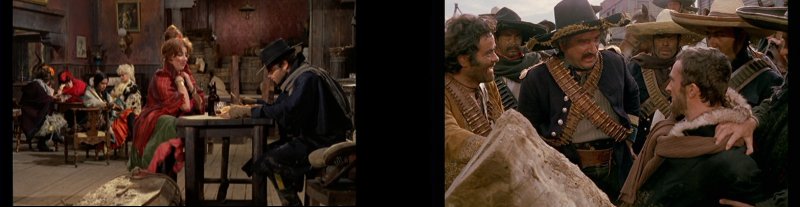
The script by Sergio and his brother Bruno Corbucci is certainly strong - like Leone before him, Corbucci tries to turn genre conventions on their head and does so from the very first scene when the lead character arrives without a horse, almost unheard of in the Western. The character of Django takes the role from Leone's stories even further into anti-hero territory and would become an inspiration for many of the later Spaghetti Western characters - unlike many of these however he is very fleshed out here with some interesting character traits. Although he shows kindness to Maria there is no love implied at all (at least not in the Italian language script, the English translation adds some hints of interest), he is also very fixated with gold and prepare to go to great lengths to get hold of it, usually the trait of a villain. Amazingly this lust for the gold makes him forget about seeking revenge on Jackson and he is prepared to head off with the gold, start anew and bury his past forever - this is a side to the character rarely explored in the myriad of sequels where he is usually a pure avenger.
Less effective is the character of Major Jackson and his entourage who are made into Klu Klux Klan style figures with red hoods and who are seen carrying burning crosses and attempting to burn Maria at the start of the film to 'purify her sins'. In a common Corbucci sequence we see Jackson himself enjoying the sport of shooting random Mexican prisioners who 'refused to pay'. This characterisation does come across as rather unnecessary, the film would have worked fine if Jackson's group were merely ex-American Confederate soldiers trying to smoke out the group of Mexican revolutionaries hiding in their states. This would have made neither side implicitly bad and given the film an interesting edge. As it is, Jackson is made into an irredemably bad and even evil character, at odds with the rest of the characters who rarely fall into either camp. The Mexicans are pretty standard revolutionaries although they seem to be rather too thin on the ground even for a small revolution.
The Mexican revolution would become a focal point of many of the more political Westerns, including Corbucci's own Companeros (1970) but here it forms only a backdrop to the film and Corbucci himself avoids any of the political messages of his later works and although there is certainly racism present from the Major Jackson character, it is not as important as it was made in his earlier Navajo Joe (1966). Instead Corbucci seems to have focused all his efforts on giving the film a grim and near nihilistic atmosphere and does so in a way that none of the later immitators were ever able to replicate. The film moves quite slowly but the action scenes are well timed and none come off as gratiuitous. The climax and conclusion fit perfectly to the film's tone.
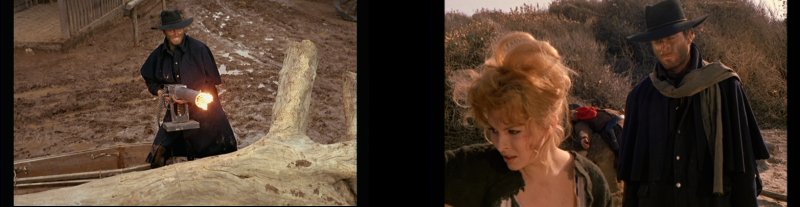
Behind the camera, Sergio Corbucci was already an experienced Western director, helming Minnesota Clay (1965) and Massacre at Grand Canyon (1965) the year before and Navajo Joe (1966) earlier that year. Django allowed him a chance to show off some very strong directoral style - the fist fighting scenes are very strong, with fast camera angles and point-of-view handheld camera shots to bring the viewer into the action. Corbucci uses the unusual 1.66:1 format for this film, most Westerns using the wider 2.35:1 scope ratio to help convey 'epic' landscapes, this ratio allows the action to seem much smaller in scale bringing a more desolate, dirty feel to the picture, as well as in the interior scenes and the zooming and facial close-ups that Corbucci uses frequently - he would use it well again in The Great Silence (1969). Set and costume design is very distinctive, the muddy streets of the main town and the dirty abandoned buildings look a long way from the usual dusty, desert towns and match the script's attempts to invert the genre norms. The distinctive red hoods of Jackson's men give them a very sinister look, like something out of a German gothic horror film or Krimi.
Stunts are kept to a minimum and look realistic, only a fist-fight in the saloon showing any real stunt work and while there is a little blood on show and a character gets his ear brutally cut-off, this is a long way from the later blood soaked, squib packed productions, which all generally helps the film manage a much more realistic feel than many of the other Spaghetti Westerns. The soundtrack by Luis Enríquez Bacalov is simply superb and pushes the film into iconic territory. The theme of the opening Django ballad crops up frequently in various instrumental variances throughout the film, Jackson and his men gets a heavy and sinister sounding string theme while Rodriguez's gang get a lively guitar accompaniment. Only at the very ending does the music sound inappropriate, rather too upbeat and lively.
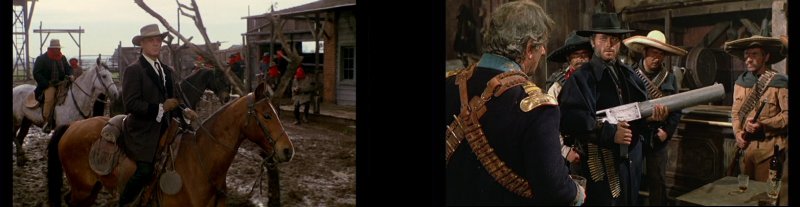
Franco Nero is here making his debut leading role and looks very strong; although the character of Django does not often go in for emotion, by the end of the film he looks completely exhausted and broken. Corbucci regulars play two of the main roles - Eduardo Fajardo as Jackson manages to avoid his character becoming comic-book evil and looks very fitting as an ex-military man, while Gino Pernice appears as the doomed Jonathan. José Bódalo is good as Mexican leader Rodriguez; often lively and jovial, he can believably become very angry and would reprise a very similar role in Corbucci's Companeros (1970). Loredana Nusciak gives a strong but sadly underused performance as Maria and would play a very similar role in an unofficial sequel, 10.000 dollari per un massacro (1967) with Gianni Garko.
Django is considered to be one of the most important Spaghetti Westerns filmed and with good reason. Although not the first of the genre, and certainly not as well known as the Sergio Leone films, it achieved strong popularity accross Europe and its directoral style and brooding anti-hero would inspire many films in the next decade - over 50 of them carrying the name Django in their title. While many of the later Spaghetti Westerns would come under the comedy or action banners, Django is a pure Western. A trend setter for many of the films to come, anyone interested in exploring beyond the realm of the famous Sergio Leone Italo-Westerns would do very well to check out this classic film. Highly recommended to all.
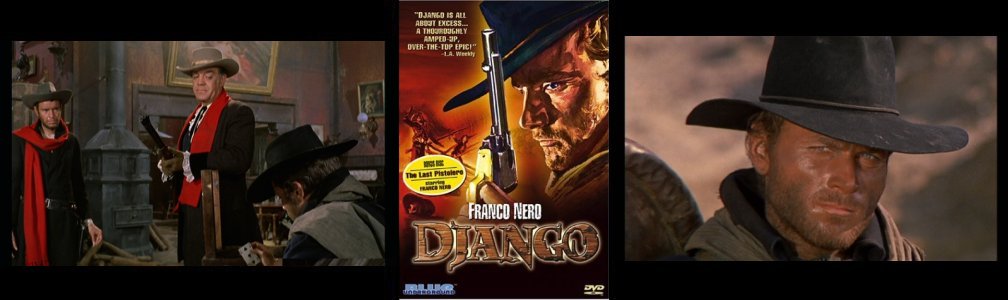
| Anyone famous in it? | Franco Nero - in his first leading role, he would appear in Westerns until the genre died out with Keoma (1976) |
| Directed by anyone interesting? | Sergio Corbucci - one of the great Spaghetti Western directors behind classics like Hellbenders (1967) and The Great Silence (1969) he declined in later years, finishing with Il Bianco Il Giallo Il Nero (1975) |
| Any gore or violence ? | A few Western shootouts, some blood and one brief gory ear cutting scne. |
| Any sex or nudity? | None. |
| Who is it for? | Highly recommened to all, a great starting place to explore the Italian-Westerns. |
| Visuals | Original Aspect Ratio - 1.66:1 anamorphic wide-screen. Colour. The image is average, some shots are very grainy with frequent print damage while others are much better quality. Always watchable and the jumps in quality are not jarring. Probably the best the film will ever look. |
| Audio | English and Italian tracks - Dolby digital mono. Both tracks sound fine, the Italian track has better dubbing. |
| Subtitles | English for whole film, based on Italian track. |
| Extras | The film disc includes:
The second disc (a mini-80mm DVD that should play fine on most players) includes:
|
| Region | Region 0 (ALL) - NTSC |
| Availability | Also available as a single disc without the short film. |
| Other regions? | Various releases of this film although none are superior to this disc. Argent R0 UK DVD offers new interview with Nero and Alex Cox (film reviewer) but has lower picture quality. |
| Cuts? | The film is believed to be fully uncut and includes small bits of footage that were not present on most earlier prints. English language print. |