Text from this review not to be used without authorization.
Please contact:


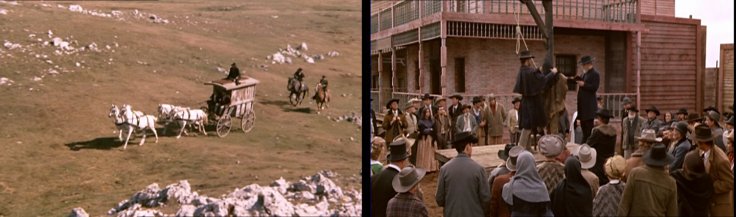
Django (Terence Hill) is the happily married assistant to newly elected politican David Barry (Horst Frank). While working as escort on gold shipment, Django is ambushed by a gang lead by Lucas (George Eastman), under the command of Barry - his wife is killed and he is left for dead. Five years later, Django is working as a town hangman, although he is secretly keeping the men alive - the men he saves are not guilty, but have been set-up by Lucas to take the blame for his frequent gold robberies. Django plans to use his secret army to take revenge on Lucas and protect the gold shipment, but he is betrayed and captured...
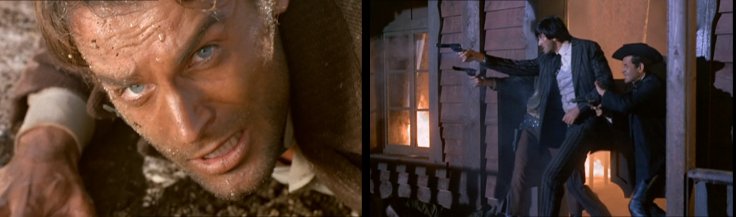
Writer and director Ferdinado Baldi is best known for his more unusual Spaghetti Westerns, from the deeply plot focused Texas Addio (1966) and Greek tragedy inspired Gunmen of Ave Maria (1969) to the bizarre Blindman (1971) and the genre-parody musical Little Rita nel West (1967). Co-written with frequent collaborator Franco Rossetti, Preparati La Bara is a rather more conventional genre entry, taking clear inspiration for Sergio Corbucci's classic Django (1966) - a film that the pair had already cleverly parodied in Little Rita. The storyline is rather simplistic - we know from the start who betrayed Django, so it is a very straight forward bit of revenge with no real surprises and even in this early stage of the genre, there is nothing particularly original here. Fortunately the fair mix of action and storyline keeps the pacing strong and the second half picks up noticably to build to a dramatic climax.
Already an experienced Western director, Baldi does good work throughout with some real touches of flair - he uses very quick camera angle changes in his fist fights to good effect (much more assured than in Texas, Adios (1966)) while the action scenes look great with some splendid but realistic stuntwork on display. The production is strong - the sets and exteriors look great and are well populated by extras, while a set-piece in a blazing saloon is a real highlight with dramatic stunt work. The typical ballad theme song of the early Spaghetti Westerns is used here, but followed with some more varied themes that work very well.
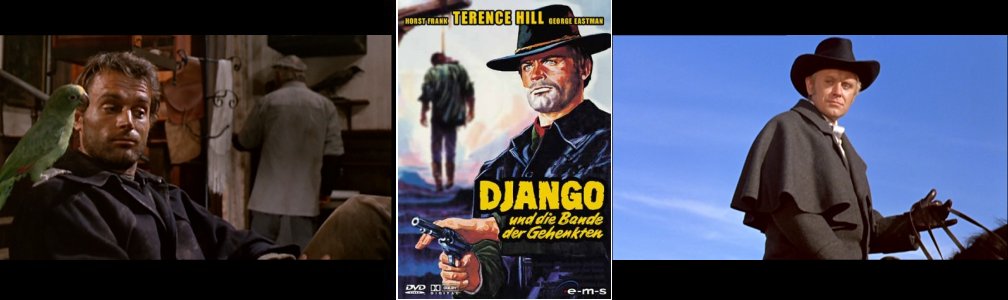
The experienced Euro-cult cast all do very well. Having made a name for himself in several of the popular German Karl May Westerns and impressing in Baldi's musical Western Little Rita nel West (1967), Terence Hill in his first genre leading role gives a very solid performance as Django and mimics Franco Nero's performance to perfection, especially the patented look under the brim of the hat. While he is better known for his later Western comedy roles, his performance here is straight up and highly convincing and he would have made a very good serious actor. German character actor and genre regular Horst Frank is sufficiently menacing as the chief villain, without going over the top, while the ubiquitous George Eastman looks suitably threatening as Lucas and a whole host of familiar genre faces make up the supporting cast.
Preparati La Bara is a very entertaining and thoroughly recommendable Spaghetti Western. While not as striking as the classics from Leone or Cobucci, or as varied as Baldi's other genre entries and despite a rather generic storyline, top acting and solid direction throughout make it endlessly rewatchable. A must see for genre fans and a great starting place to start exploring the lesser known genre titles.
| Anyone famous in it? |
Terence Hill - star of many Euro-cult films from the 1960s onward including the comic Trinity films. Horst Frank - German character actor who played Dr. Braun in Argento's Cat O'Nine Tails (1971) George Eastman - notiorious as the killer in video nasty Antropophagus (1980) |
| Directed by anyone interesting? | Ferdinando Baldi - a lesser known Italian director, but who made a number of Spaghetti Westerns, from the storyline focused Texas, Addio (1966) to the bizarre Blindman (1971). |
| Any gore or violence ? | Typical Western brawls, nothing bloody. |
| Any sex or nudity? | None. |
| Who is it for? | Recommended to all Spaghetti Western fans and would appeal to fans of Westerns in general. |
| Visuals | Original aspect ratio - 1.78:1 anamorphic wide-screen (some slight hints of cropping at the top of the print). Colour. The image is good with some minor damage in places although the digital transfer is low bit-rate some some artifacting is noticable at times. [Note: the film was not shot in 2.35:1 as IMDB reports, but in a 1.66:1 ratio and shown in 1.78:1 in Italy and the USA.] |
| Audio | English and German language dubs - Dolby digital 2.0 mono. The German track sounds slightly canned, the English track sounds very good. |
| Subtitles | None |
| Extras | The disc includes:
|
| Region | Region 0 (ALL) - PAL |
| Availability | DVD Title: Django und die Bande der Gehenkten |
| Other regions? | Released by Arrow UK on Blu-Ray and Arrowdrome on DVD, includes Italian audio with English subtitles as well as an English dub track, the Blu-Ray also includes a booklet and documentary. Available from 3L Vertriebs in Germany on Blu-Ray as Django und die Bande der Gehenkten with English, Italian and German audio but with forced German subtitles. The Joe der Galgenvogel re-edited comedy version is available on DVD and Blu-Ray in Germany with no English options. |
| Cuts? | The film is believed to be fully uncut. The film is from the Italian print, so titles and credits are in Italian. A comedy edit was created later in Germany to cash in on the success of Hill's comedy films, that print is known as Joe der Galgenvogel with cuts to violence for an FSK12 rating and a completely new dubbing track, it is not available in English. |