Generally good print for much of the runtime with good colours and detail and only light grain, but there is quite frequent print damage (sometimes very serious) and dropped frames. Always watchable though.

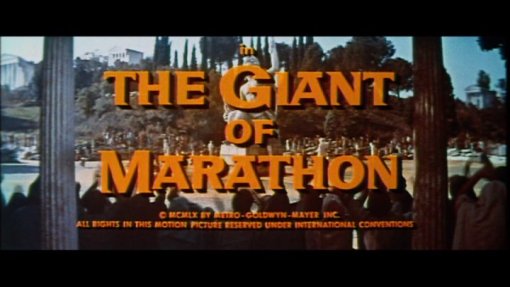
The Olympic games are dominated by one individual, the Athenian, Phillipides (Steve Reeves) who seems to win at every event - returning home to Athens he is put in charge of the elite city guard. Unfortunately, Phillipides is in love with the beautiful Andromeda, who has already been betrothed to the city's most prominent citizen Teocritus. Phillipides discovers that Teocritus is supporting a campaign to reinstate the city's recently deposed dictator Hippias with the support of the Persian leader Darius. With the threat of war impending, Phillipides makes a desperate journey to ask the Spartans to help defend the city from the invading army and the Greeks and Persians clash on the field of Marathon...
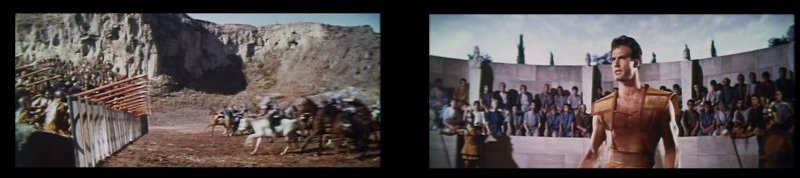
Inspired by the historical battle, Giant of Marathon's script does contain a very basic overview of the history (and its associated legends) - most notably the lead character of Phillipides. History remains confused over the existance of Phillipides and whether he ran to Sparta to enlist their help, or from Marathon back to Greece to tell of victory. For good measure the script has him do both, but instead of merely running home to Athens to announce their victory, he more heroically carries a warning of a naval attack (and perhaps unsurprisingly does not drop dead on his arrival). This assault itself, as well as most of the eponymous battle is pure fiction - in reality the Greeks pushed the Persians back to their ships and sent them fleeing - rather than the overnight stalemate that the battle appears to lead to here.
In tone the film is certainly different to the Traditional Pepla of the era, eshewing the fantasy of the Hercules films and more closely following the style of the American historical epics. Accordingly the first forty minutes of the film are completely without any action scenes (with the exception of a slightly gratuitous brawl between Phillipides and a wrestler), instead we get some real plot development and characterisation - with political intrigue, characters with hidden motives and lots of secret meetings. This build-up helps to make the inveitable battle scenes all the more tense and the dramatic climax very strong. Even the romantic themes do not feel tacked on and are well combined with the story. Pacing is obviously on the slower side, but the film certainly does not drag and indeed the dialogue scenes actually play better than the overlong fight scenes that often punctuated the sword and sandal movies.

French born director Jacques Tourneur would seem to be curious choice to helm the film, although at the time the Italian film industry was still considered to be recovering from the Second World War and several veteran Hollywood directors were brought in to helm the bigger budgeted Sword and Sandal epics (c.f. Robert Aldrich on Sodom and Gomorrah (1962) and Edgar G. Ulmer on Hannibal (1960)). Tourner appears to do some good work, although it is immediately obvious from watching the film that a lot of the style and look of the project was the work of credited cinematographer Mario Bava - it is widely documented that the impressive battle scenes were entirely his own work and this is readily apparent when these scenes are compared to later Bava projects like Gli Invasori (1961).
As in that film, Bava overcomes a modest budget with creative camera work and editing to give the battle scenes a genuinely epic feel with the well staged cavalry charge a real highlight. Even more impressive is the underwater photography in the climactic naval battle that was clearly not just filmed in a swimming pool. Less usual for Bava however is the amazing brutality of the battle scenes, with a lot of blood and injury that would be surprising to see in such a film even now. Frequent Bava co-worker Roberto Nicolosi (responsible for the sappy romantic score that almost ruined Black Sunday (1960)) provides a more suitable soundtrack here.

Steve Reeves was the star behind the Peplum boom and was the obvious choice for the lead role here, particularly after his work in the historical peplum The Last Days of Pompeii (1959), however the effects of the shoulder injury he sustained there are noticable in his lessened physique here. Fortunately this is rather more appropriate for this particular role where he is require to act more than fight and he gives a surprisingly strong performance throughout. His love interest is played by the stunning and rather scantily clad French actress Mylène Demongeot. Future genre star Sergio Ciani (better known as Alan Steel) gets a brief role playing a Spartan warrior.
Boasting a stronger than usual storyline, some assured direction and brutal epic action scenes (but not paying too close attention to the history books), Giant of Marathon is a very enjoyable example of the Historical Epic Peplum and recommended to fans of both genres. Mario Bava fans should certainly enjoy this one as a chance to see the director's trademark action scenes in use.
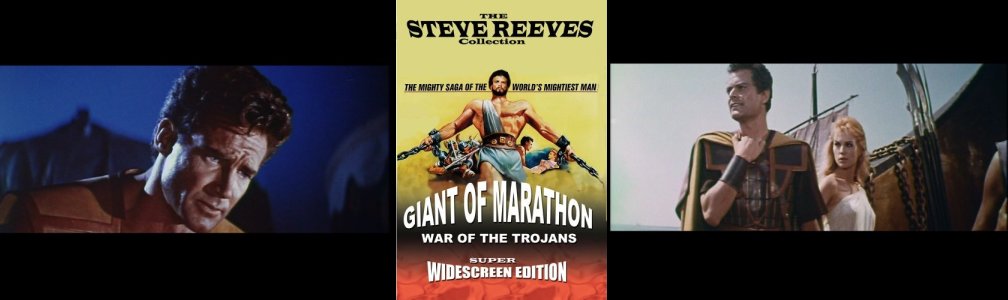
| Anyone famous in it? | Steve Reeves -- the big American Peplum star who kicked the genre off with his lead role in Hercules (1958) |
| Directed by anyone interesting? | Jacques Tourner - French born director best known for his Val Lewton produced horror films of the 1940s.
Mario Bava - The Italian director best remembered for his atmospheric horrors, including Black Sunday (1960) |
| Any gore or violence ? | Some surprisingly bloody deaths, although nothing particularly gory. Some very harsh looking horse falls. |
| Any sex or nudity? | None |
| Who is it for? | Certainly for fans of Historical Epics and the Historical Pelpa. Of strong interest to Mario Bava fans. |
| Visuals | Original Aspect Ratio - 2.35:1. Anamorphically enhanced. Colour. Generally good print for much of the runtime with good colours and detail and only light grain, but there is quite frequent print damage (sometimes very serious) and dropped frames. Always watchable though. |
| Audio | English mono - sounds fine most of the time, although there are some drop-outs and jumps. |
| Subtitles | None |
| Extras | None |
| Region | Region 0 (ALL) - NTSC |
| Availability | Only as part of the Steve Reeves Collection - a two film, single disc collection also featuring War of the Trojans. |
| Other regions? | Available on several low quality public domain discs in the US, including a cropped but partly widescreen Alpha DVD. |
| Cuts? | The film is believed to be uncut. The American theatrical print was cut of the bloody scenes before release but they are intact here. The print has English titles. |
