Text from this review not to be used without authorization.
Please contact:

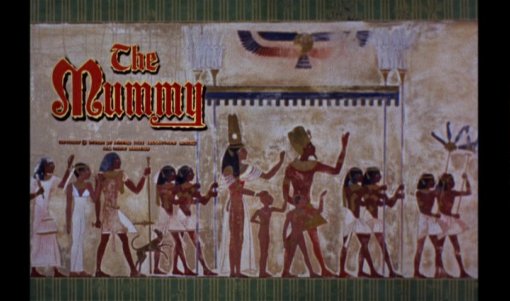
With the global success of Horror of Dracula (1958) and Curse of Frankenstein (1957), Hammer Films made a co-production agreement with Universal International in America, allowing the British studio to take advantage of the multitude of classic horror titles owned by the American company. Phantom of the Opera (1961) and Curse of the Werewolf (1961) were to follow, but first came The Mummy:
Egypt, 1895; Stephen Banning, his son John (Peter Cushing) and Joseph Whemple are digging for the tomb of Princess Ananka. Eventually they find it but tragedy strikes - left alone in the tomb for a moment, Stephen Banning sees something that sends him insane. Three years later and back in the UK, Stephen (committed to a nursing home since the events of the prologue) attempts to convince his son that a mummy is after him, but fails. However he is right - Mehemet Bay, a dedicated servant of the god Karnak has brought Kharis (Christopher Lee) a living mummy from Egypt, to reek revenge on the three men who desecrated the tomb of Ananka. Kharis breaks into Stephen Banning's room and brutally kills him. Recalling the legend behind Ananka's burial and the burying alive of Kharis - cursed to protect the tomb of Ananka for all time - John realises that there is a mummy out there and it has been ordered to kill him...
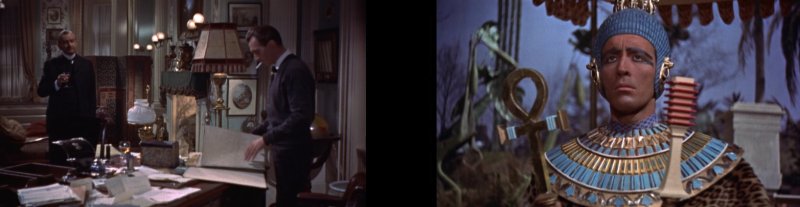
Based on the five films in the Universal horror series Jimmy Sangster's script takes the revenge seeking Kharis from The Mummy's Hand (1940) while borrowing the forbidden love angle from the original The Mummy (1932) and using Hammer's regular period settings instead of the contemporary settings of the Universal titles. Fortunately this mix of sources does not confuse the storyline and the film boasts an effective script. As usual with Sangster's early horror works there are only a few characters here, allowing him to focus almost entirely on John Banning and providing enough characterisation to make the audience care whether he lives or dies, compared to the stream of minor characters who are killed off in many other similar films. There are a few minor characters from the village who are used to provide a light comic relief but it is only brief and actually quite amusing. Like Hammer's other period horrors, The Mummy is quite slowly paced in comparison to a modern horror film but never drags and has several dramatic and very creepy highlights building to a very effective conclusion.
Terence Fisher directs the duo for the fourth time in the period setting that he had become very accustomed to and the film has his usual mix of long tracking shots but pretty standard camera angles and straight forward photography. He does experiment with some more unusual aspects in a few scenes - the scenes in Ananka's tomb are bathed in red and green light more akin to the work of Mario Bava and his followers. The production design is highly impressive, an Egyptologist was brought in to ensure that all the details were totally accurate, the highlight being a lengthy funeral procession properly equipped with artefacts and authentic costumes. The British sets also look solid and Banning's study shows Hammer's typical attention to deal. Franz Reizenstein gives a very big and impressive score with some very nice choral elements, that manages to outdo even the elaborate Universal scores of the 1930s.
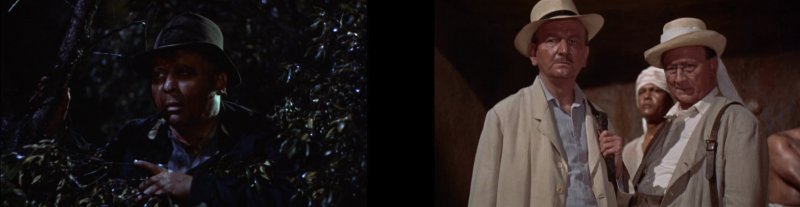
After a brief chance to play a normal man opposite Peter Cushing in Hammer's less sucessful Hound of the Baskervilles (1959), Christopher Lee returns to the role of the monster. Inbetween his Dracula - an unsympathetic, evil character - and Frankenstein's creation, a deeply tragic character, Lee gives the Mummy a sense of determination but also of emotion in later scenes. An extended flashback to 2000 BC gives him a chance to play Kharis prior to mummification, just as Boris Karloff was afforded in the 1932 film. Peter Cushing brings his usual charm and attention to detail to his role and some lively action to the fight scenes. The rest of the cast similarly pull their weight and the usual Hammer regulars are on hand in the background, Michael Ripper and George Woodbridge should be instantly recognisable.
With a well written storyline, solid direction and the usual strong acting from Cushing and Lee, The Mummy is an impressive film which stands out as one of Hammer's best entries and comes Highly Recommended.
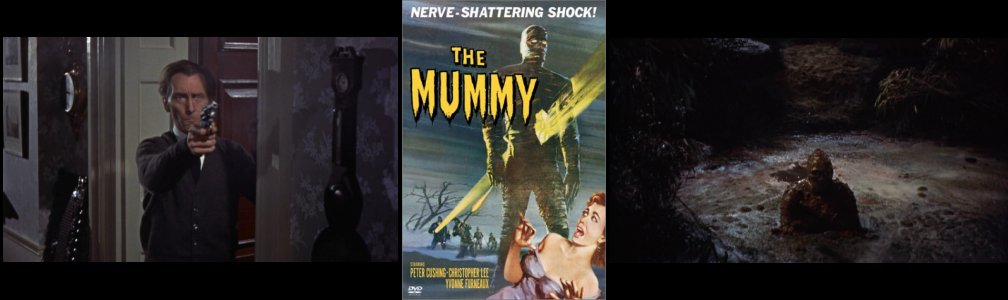
| Anyone famous in it? |
Peter Cushing - one of Hammer's biggest stars, he also appeared in their Evil of Frankenstein (1964) Christopher Lee - made his name with Hammer and went on to appear in The Wicker Man (1973) |
| Directed by anyone interesting? | Terence Fisher - Hammer's main director at the time, he directed Curse of Frankenstein (1957) and Horror of Dracula (1958) as well as most of the Frankenstein sequels. |
| Any gore or violence ? | The Mummy takes several gunshots and there are several brutal but bloodless fistfights. |
| Any sex or nudity? | None |
| Who is it for? | Certainly for fans of Hammer Horror and Mummy films. |
| Visuals | Original Aspect Ratio - 1.85:1 widescreen (although titles and first shot are in 1.66:1). Anamorphically enhanced. Colour. The image looks great, some very light grain and speckles, but nothing noticable. The 1.66:1 ratio of the titles is the original UK ratio, the print would have been matted to 1.85:1 for US release. |
| Audio | English language mono - sounds good French and German mono. |
| Subtitles | English, English HOH, German, German HOH, French, Swedish, Danish, Turkish, Greek, Arabic |
| Extras | The disc includes:
|
| Region | Region 2 (UK, Europe) - PAL |
| Availability | Released as a single disc or in the Hammer Horror Originals boxset, along with Curse of Frankenstein (1957) and Horror of Dracula (1958). Both of these are now out-of-print and hard to find in the UK. |
| Other regions? | Identical releases in the US and across Europe. |
| Cuts? | Fully uncut. Print used is English language. |