Text from this review not to be used without authorization.
Please contact:

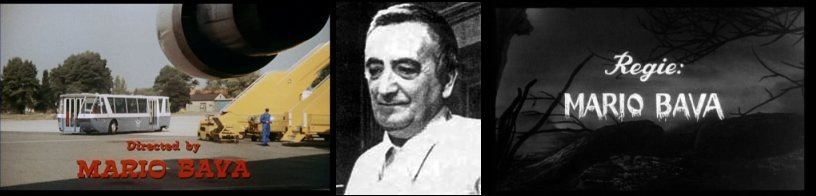
Born July 1914 in Italy, Mario Bava was raised in an artistic environment, his father Eugenio was a special effects designer and pioneering cinematographer who worked on films from the very first Italian productions, including the silent epic Cabiria (1914). Mario trained as a painter but moved into films in the mid-1930s, working as a production assistant and making a regular income designing the Italian language credits for imported American films - however this work dried up when the import of American films ceased in the run up to the Second World War. With Italian producers less forthcoming on wages (Bava was never paid for lengthy work on the title sequence for Scipione l'africano (1937)) the newly married Bava was encouraged by his wife to train as a cinematographer - he secured an assistant position under veteran cameraman Massimo Terzano (who had worked on Maciste all'inferno (1925)) and subsequently worked for director Francesco De Robertis on the propaganda film Uomini sul fondo (1941), however after the Allied invasion of Italy and the country's surrender in 1943, work became very hard to come by and Bava struggled to keep his family, including his som Lamberto born in 1944, in the basics for several years. Things finally changed when Bava's work on a self-directed documentary Antonia da Padova about Saint Antonia, was brought to the attention of producer Carlo Ponti who hired Bava as a regular cinematographer on a variety of projects including the musical I pagliacci (1948) starring Gina Lollobrigida.
His talent caught the eye of director Riccardo Freda who hired Bava to photograph the arena sequences in Spartaco (1953) and the pair soon became friends, with Bava working on effects shots for several of Freda's productions including Beatrice Cenci (1955). A keen innovator, Freda called on Bava to help him on a horror film I Vampiri (1956) - at the time there was no heritage of Italian horror and this would be the first genre film to be made in Italy since the silent movie era, it was also a year before the great gothic horror boom started by Hammer Film's Curse of Frankenstein so the producers were only tempted to put up funding for this risky project when Freda assured them that he could have the shooting completed in a fortnight. With ten days shooting completed and only half of the script filmed, Freda had a row with the producers and stormed off the set, leaving Bava to become the unwilling director. With just two days filming time remaining, he changed the script considerably to fit the existing footage and require a minimum of new shooting, leaving the film with a surprisingly coherent final cut (although like many of his later horror films, it would be crudely re-edited for American release as The Devil's Commandment).
Unfortunately I Vampiri did not have the hoped for box office success as Italian audiences baulked at the idea of a home-made horror film. American productions were continually outperforming their Italian rivals and Bava again found work scarce and poorly paying, until he was hired by the Galatea Film company to photograph a pair of small sword and sandal movies, Fatiche di Ercole (1958) and Ercole e la regina di Lidia (1959) starring former Mr Universe Steve Reeves. Passed on by the major studios they were picked up by American distributor Joseph E. Levine and given massive promotion across the US, leading to a sudden influx of American co-production money for a stream of similar historical epics which became known as the Pepla. Freda called in Bava again to serve as cameraman on his own film Agi Murad il diavolo bianco (1959) but he felt that this clever cinematographer was getting insufficient credit for his work and after hiring Bava to photograph his next attempt at horror Caltiki - il mostro immortale (1959), he walked off the set after a few days, forcing Bava to take the director's chair and allowing the producers at Galatea Film to see his potential. This was further demonstrated when director Jacques Tourneur's disinterested work on the epic battle scenes in La battaglia di Maratona (1959) was too poor to make the final film. Bava again stepped in to direct these, using all of his usual tricks he was able to create the film's highlight battle scenes with only a small cast of extras. As appreciation from Galatea, he was given an unprecidented carte blanche to direct his own project.

Inspired by the increasing popularity of Hammer's gothic horrors, Bava decided to return to the genre, adapting a tale that he used to read to his young children, Russian writer Nikolai Gogol's Viy. Although nervous about how his directoral debut would affect his established reputation as a cinematographer, the resulting La Maschera del Demonio (1960) proved incredibly successful and boasted some of the most effective gothic horror visuals ever filmed. Seeing the biggest money in overseas sales and to camouflage its Italian roots, British actors were cast in the leading roles (John Richardson and Barbara Steele) and despite re-editing by AIP in the US (where it was released as Black Sunday) it proved highly successful, although it was rejected by the BBFC for release in Britain and did not emerge here until 1968 as Revenge of the Vampire.
Before the massive success of La Maschera del Demonio became evident and would firmly root Bava into the world of the supernatural, his talent for photographic epic-looking films on a low budget made him the obvious choice to helm Galatea Film's cash-in on the success of Kirk Douglas' The Vikings (1958) known as Gli invasori (1961) in which he re-used a lot of the tricks from his earlier work on La battaglia di Maratona to give the film a large scale feel. The main cast, including lead actor Cameron Mitchell were subsequently re-cast in a quick follow-up L'ultimo dei Vikinghi (1961) and it is believed that Bava may well have again stepped in as uncredited director on some scenes, although no information exists on how much of the film he worked on. Similar ambiguity surrounds the extent of Bava's work on the large scale American/Italian co-production Esther and the King (1960), he is officially credited as director of photography but some sources suggest that he actually directed a number of scenes.
Bava certainly did work as co-director with American film-maker Henry Levin on probably his most overlooked film, the Arabian Nights fantasy Le meraviglie di Aladino (1961), although to confuse issues the French language titles see the production credited as a 'Henry Levin film' with Bava alone credited as director. Fortunately there is no ambiguity over Bava's next production - Ercole al centro della terra (1961). While Galatea's owner Lionello Santi had decided to stop making Hercules films after the success of their first two productions, the Italian audiences could not get enough of the adventures and Bava was called on to helm the hellbound Peplum starring British muscleman Reg Park and fellow countryman Christopher Lee as the villain - despite the typically light hearted ethos of the genre, Bava turned the film into a surprisingly dark horror story and used every camera trick at his disposal to provide an elaborate infernal setting.

As the success of his first film became apparent, AIP (American International Pictures) who had distributed Black Sunday very profitably, were keen to back his subsequent projects and Bava was able to work on more personal productions again. His last film in black and white, La ragazza che sapeva troppo (1963) was a Hitchcock inspired thriller (the title translating to 'The Girl Who Knew too Much') that marked his first contemporary thriller and the first steps towards the creation of the Giallo genre. Actively involved in the production from the start, the American producers insisted on a much lighter tone for their version of the film and the complete excising of references to marijuana, prompting Bava to shoot several additional sequences which would only appear in the exported Evil Eye titled cut. The film was again a success, but with the Gothic Horror boom now in full swing and his past work on the genre proving so profitable, Bava was pressured into working on another horror project. His I tre volti della paura (1963) was a three part anthology film, its highlight being the Tolstoy inspired chapter The Wurdalak starring veteran horror icon Boris Karloff and allowing Bava to use the rich colour photography of his earlier adventure films to create an elaborate gothic environment.
The opening chapter The Telephone was another early Giallo-esque development although the overt lesbian undertones proved too much again for AIP who substantually re-edited the chapter to turn it into a more conventional horror story in their release, entitled Black Sabbath. Such editing alone would not make AIP accept Bava's subsequent period horror La frusta e il corpo (1963) for distribution. Although looking on first impressions like a rather conventional gothic horror, the film took a more distinctly thriller inspired approach to the material and incorporated a number of Sadean-sexual themes into the mix that proved too much for even the Italian censorship board to permit (Bava and most of the crew used pseudonyms after the producers feared obscenity charges) - for the British release large chunks of the film were simply removed but AIP were unwilling to release such an incoherently re-edited film into cinemas and the film that many writers consider to be Bava's best production was released uncut by a small distributor under the baffling title of What? and gained no critical or audience attention.
Having played with thriller themes in La ragazza che sapeva troppo and The Telephone chapter of I tre volti della paura, Bava helmed what is now considered to be the first true Giallo film Sei donne per l'assassino (1964). Another carte blanche project stemming from the continuing financial success of his horror projects, the film employed a large number of the themes and ideas that would become genre traits - from the masked, leather gloved killer to the fashion-world setting and largely female cast, but most importantly it took delight in showing the gory details of the killings and they became the highlight of the film. Its direct influence can be felt in the subsequent films of Lucio Fulci, Dario Argento and Sergio Martino among others. In the lead role Bava cast American actor Cameron Mitchell, who had previously appeared in his Viking adventures - although never usually one to make social connections with his actors, Bava considered Mitchell to be one of his closest friends and the actor would often speak highly of Bava.

In complete contrast, Bava's next project, the Western La strada per Forte Alamo (1964), was a very conventional project showing only minimal influence from Bava's hand. After production of the American Westerns slowed at the beginning of the 1960s Italian producers shot a number of Old West films domestically to satisfy local audience demands - using Anglicised credits and casting American or British actors in the lead roles they passed the films off as imported American product and turned a fair business. A long time Western fan, Sergio Leone would soon reinvigorate the rather tired genre with Per un pugno di dollari (1964), breaking the Italian films away from being mere imitations and kick-starting the Spaghetti Western boom, but Bava had no particular love of the Westerns and was content to make a film that could readily pass as a 1950s American production, only the studio-set night time scenes and use of matte-paintings (in a desperate attempt to make an Italian quarry look like Monument Valley) provide any real trace of his authorship.
A one-off venture into the world of science fiction came with Terrore Nello Spazio (1965). Bava once again proved himself master of the low budget, giving the film a stunningly other-worldly visual feel despite being confined to a handful of small sets. His personal touch is much less visible on his next two projects - for Spaghetti Western title Ringo del Nebraska (1966), Bava was brought in after the original director Antonio Román was fired from the project for his slow progress and although solidly directed there is none of Bava's style visible at all (Bava himself never received on-screen credit for his work as Román had to be kept on for Spanish quota purposes, his involvement in the film was not recognised for many years). Bava did at least get his name on the credits of I Coltelli del vendicatore (1966) which was another salvage project. A heavily Western inspired Viking story, the production ran out of money part way through filming leading to Bava having (once again) to improvise a script and complete filming in less than a week - the lead actor was his old friend Cameron Mitchell who had not planned to return to Europe for the reshoots but jumped at the chance to work again with Bava. It was during this period that Bava's son Lamberto started to work with him, getting his first credit on Terrore Nello Spazio and subsequently working on most of his father's films.
Bava would finally get the chance to work on his own project later in the year after making a Freda-eqsue bet that he could shoot a horror film in just twelve days - Bava was able to hold up to his side of the bargain and completed the curiously named Operazione paura (1966) in the alloted time. The title (translated as Operation Fear) seemed to be a desperate producer's attempt to cash in on the Eurospy craze (lead actor Giacomo Rossi-Stuart had appeared in a few spy thrillers), although the US title Kill, Baby, Kill is hardly any more appropriate for the most subtle yet genuinely scary film that Bava would make. Eschewing the increasing violence and blood in European cinema and the sex that he himself had brought to the gothic horror genre in La frusta e il corpo, Bava uses nothing but the sight of a young girl dressed in angelic white to bring fear (decades before this became a staple of Japanese horror cinema). Some of his most effective direction using carefully lit, elaborate sets combined with an excellent performance from the criminally under-rated Giacomo Rossi-Stuart and a consistantly strong script serves to make this one his very best films.

Unfortunately his very best was followed by his very worst. Le spie vengono dal semifreddo (1966) was a joint producton between AIP and Italian International Pictures, both of whom intended the film to be a sequel to one of their own earlier productions and to showcase their leading talent. In the case of AIP the talent was Vincent Price and his earlier film Dr. Goldfoot and the Bikini Machine (1965) while IIP wanted a follow-up to Due mafiosi contro Goldginger (1965) featuring the popular double-act Franco Franchi and Ciccio Ingrassia. Bava was contracted to make one final film for AIP and his reputation for handling difficult productions saw him roped into what would become his cinematic nadir. Forced to rewrite the script during filming he was eventually able to present a final version of the film for the Italian market, but AIP made major changes including rewriting the script for the Englsh dubbing and extensively re-editing the film for their version which was released as Dr. Goldfoot and the Girl Bombs and is generally considered meritless.
Fortunately the film did not seem to affect Bava's standing in the film world and he was contracted by producer Dino De Laurentiis to film Diabolik (1968), an adaptation of a popular Italian comic-book. Bava relished the chance to play with elaborate set designs and his trademark creative special effects but ran into trouble with his cast - French actress Catherine Deneuve in the supporting lead role as Diabolik's girlfriend refused to disrobe for a decidedly tame nude scene and was replaced by Marisa Mell, while he later complained that John Phillip Law in the title role was unable to hold an expression for more than thirty seconds before flattening out 'like a balloon'. Bava also clashed with De Laurentiis who was worried by obsenity suits in the Italian courts against several comic book writers and forced the screenwriters to tone down the quite graphic and dark comic. Despite being offered the chance to direct a sequel using the remaining funds (the film used just 200 million lira, less than a sixth of the available budget) Bava declined, De Laurentiis would approach him again during the mid-1970s to work on special effects for his epic remake King Kong (1976), but Bava was not willing to travel to America to work on the project.
In 1968 Bava was called on by director Franco Rossi to help with the special effects on the television series L'odissea (1968), a retelling of Homer's classic Odysseus legends which aimed to follow the original tale quite closely, rather than the very loose adaptations common in the Peplum films. Bava eventually ended up directing one of the effects heavy episodes, Polifemo, which saw Odysseus's fight against the eponymous cyclops, achieved using a man in a suit and some creative perspective work. During this time Bava confirmed his statement that he could never turn down a paycheck by helming television adverts and some short futuristic promotional films for an oil company, entitled I Futuribili.

Returning to film, Bava travelled to Spain to make Il rosso segno della follia (1970), the first (and best) of what would become a trilogy of films that although containing elements of Giallo and clearly inspired by the genre, would also provide an unique twist on. In this case, the well written storyline plays out more like a psycho slasher movie with the Giallo mystery element being the identity of a killer trapped in the memory of the murderer. 5 bambole per la luna d'agosto (1970) came next, a project that was dumped on Bava just days before filming started and for which he later expressed disdaine. A rather minimalistic Giallo story with very slow pacing and an almost complete lack of on-screen kills, it did allow Bava the chance to play games with the genre - at one point early on we clearly see the identity of the killer, only for the later scenes to have the killer off-screen, making their identity more confusing than normal. Bava himself proved again to be highly professional and despite his dislike of the project, puts in an impressive directoral display with a lot of his trademark camera work. It is also of interest as the only time that Bava worked with Giallo-Queen Edwige Fenech.
The final part of the trilogy was Reazione a catena (1971) which again played games with the genre (the opening murder is carried out by an unseen black-gloved killer whose identity is revealed only for them themselves to be killed by another murderer) and contained an elaborate storyline, but is most memorable for a twenty minute sequence in which four teens are stalked and vividly killed, two of them while having sex in an uncanny presage of the traits of the American slasher movie boom that was still almost a decade away. During this period he also directed his third and final Spaghetti Western Roy Colt e Winchester Jack (1971) - much like his previous two genre films, he shows little interest in the project which he apparently largely rewrote to turn the film into a comedy project (although ironically the serious scenes are the most interesting in the film).
Around this time Bava helmed probably his most unexpected project, a sex comedy Quante volte... quella notte (1972). The sex comedy was the longest running of all the Italian genres and certainly the most profitable but the films were rarely exported and usually quite worthless. Bava put his own spin on the project, creating a Rashamon inspired four-part retelling of the activities of a couple on a night out, although the script was never quite as clever as it seemed to think it was. Bava's dislike of cinematic nudity meant that the film was surprisingly chaiste for a sex comedy, in its Italian cut including only a couple of brief topless shots, the rest of the nudity being creatively hidden - still the film would not be released for two years after running into trouble with the Italian censor board, whose head, Bava's old friend Riccardo Freda later said he had been trying to do him a favour by preventing the "career suicide" film from being released.

During the early 1970s, Bava was approached by American producers to remake his debut classic La Maschera del Demonio but this project never came to anything (incidentally his son Lamberto would remake the film, going back to more closely adapt the source text, in 1989 in a film usually marketed as Demons 5: The Devil's Veil), Bava did however return to gothic horror genre with Gli Orrori del castello di Norimberga (1972). A contemporary film set in a restored castle, it provides a few interesting juxtapositions (a Coke machine sits in the middle of the castle) but never plays up the chance for spoofery, nor does it bring any of the 1970s sex and gore to the genre, leaving the film feeling rather dated. However, it proved to be a big moneyspinner for AIP and the Italian producer Alfredo Leone offered Bava a blank cheque for his next production.
The resulting Lisa and the Devil (1973) is the climax of Bava's cinematic oeuvre. Able to make a film almost completely free of commercial, exploitation influences, he was able to truly explore the dark, nightmarish atmosphere that had underlain most of his previous horror works, creating a surreal masterpiece which is now often acclaimed as his best work. Unfortanately despite a welcome reception at the Cannes film festival, the film was only picked up for distribution in Spain (where it similarly received strong reviews) and in an attempt to recoup the investment in the film, Leone rewrote the storyline to allow the use of new exorcism footage which he directed, aiming to cash in on the success of American blockbuster The Exorcist (1973). The film was re-released as House of Exorcism (1975) and picked up distribution deals but received poor reviews - devistated by the failure of the original film and its subsequent mutilation, Bava insisted on having his name removed from American prints of the film, being credited as Mickey Lion.
During the lengthy post-production on La casa dell'esorcismo, Bava found a short story from American writer 'Ellery Queen' called "Kidnapped" which he suggested to Leone as an excellent grounding for a crime film. Leone looked to buy the rights, but was beaten to the punch by his production manager Joe De Blasio who had overheard the original conversation. De Blasio started production on a film version which Bava agreed to direct, walking away from post-production on the Leone film in the process, leading to a lengthy rift between the two. Cani arrabbiati (1974) was a complete change of tone for Bava, an intensely realist and minimalist crime film with some quite shocking brutality. Unfortunately the film would not prove any less troublesome than his last project when De Blasio died of a heart attack just before the project was completed and the production company went bankrupt.

Bava asked Leone to take over production of Cani arrabbiati, but he admits to gloating over the failure of the project that was stolen from under his nose and refused to assist unless the film was substantially recast, replacing the largely unknown cast with better marquee names (Elke Sommer was suggested for the female lead), a move that would doubtless have cost the film a lot of its raw edge. In the end the film stock was seized and the rights became entangled in red tape, the production seemed doomed never to see the light of day until the mid-1990s when the lead actress Lea Leander and journalist contacts in Germany were able to settle the legal issues and secure the film print. A largely complete workprint of the film did exist and it was this that was premiered in 1996 at the Brussels Film Festival, subsequently being released onto DVD (where it apparently holds the record of the first DVD-exclusive release). Lamberto Bava however was not happy with the version of the film presented and along with Alfredo Leone filmed new sequences and comissioned a new score, re-editing the film to create a new version of the film which was released as Kidnapped.
Bava eventually reconciled with Leone and agreed to take credit on European prints of La casa dell'esorcismo, but the experience on both productions had dampened Bava's enthusiasm and his output slowed considerably. The effective if rather unoriginal contemporary horror film Shock (1977) was co-scripted by Lamberto Bava who had been working as assistant director on his father's films since the mid-1960s and Mario allowed him to direct a number of sequences here. Bava would finally pass the torch to his son when they took co-director credits on the television film La Venere d'Ille (1979). An eerie period horror piece it would mark Mario Bava's final director credit and he subsequently retired.
There should have been one final Bava film, I cavalieri delle stelle, a space-opera scripted by Luigi Cozzi in the style of Star Wars (1977) to be co-produced by AIP. Bava did a number of test shots for the blue-screen effects that would be required but eventually left the production after a disagreement with the Italian producer Fulvio Lucisano (pre-production rolled on into the mid-1980s with Cozzi attached to direct before the project was finally abandoned). Bava did briefly return to film-making to assist long time fan Dario Argento (who has openly credited Bava as the inspiration for his directoral style) on the special effects for Inferno (1980). In the same year, Lamberto Bava presented his debut film, the ususual, atmospheric horror Macabro (1980) - after seeing the film at its premiere, Bava remarked that he could now die happy and in April 1980 he died of a heart attack aged 65.
A Bay of Blood (1971)Anchor Bay US Region 0 DVD |
One of Bava's three twisted Giallo, the catch here is a fascinating slasher movie set-piece.
Of interest |
Baron Blood (1972)E-M-S German Region 2 DVD |
Bava's last return to the gothic horror genre is let down by an unimpressive storyline and a lack of tension.
Not recommended. |
Blood and Black Lace (1964)E-M-S German Region 2 DVD |
Bava's rather simply plotted thriller would define a generation of Italian Giallo films.
A must see for Bava or Giallo fans. |
Cani arrabbiati (1974)Anchor Bay US Region 0 DVD |
Bava's taughtly plotted real time crime film is a brutal masterpiece showing his incredible versatility.
Recommended |
Danger: Diabolik (1968)USA Paramount Region 1 DVD |
Bava's masterly direction brings a true comic-book atmosphere to this well directed and scored film.
Recommended. |
Five Dolls for an August Moon (1970)USA Anchor Bay Region 1 DVD |
Mario Bava's return to the Giallo after six years is a very unusual take on the genre he created.
Of interest to fans. |
Four Times that Night (1972)USA Anchor Bay Region 1 DVD |
Mario Bava's sex comedy has some interesting ideas but they are poorly developed.
Of interest but not recommended. |
Gli Invasori (1961)German Colloseo Film Region 2 DVD |
An exciting Viking adventure film, with excellent direction making up for a hole-filled script.
Recommended. |
Hatchet for the Honeymoon (1970)UK Odeon Region 2 DVD |
A cleverly written and well directed psycho killer take on the Giallo.
Recommended and one of Bava's best |
Hercules in the Haunted World (1961)USA Image/Fantoma Region 1 DVD |
A well directed hellbound Traditional Peplum with a top-notch euro-cult cast including Christopher Lee. From Mario Bava.
Recommended for an entertaining watch. |
House of Exorcism (1975)Anchor Bay US Region 0 DVD |
Alfredo Leone's exploitation edit of Bava's masterpiece with crude exorcism scenes inserted.
Painful yet fascinating to compare. |
Kill Baby Kill (1966)Anchor Bay US Region 0 DVD |
The culmination of Bava's 1960s gothic horrors is this outstandingly atmospheric and genuinely scary film.
Highly recommended. |
Knives of the Avenger (1966)German E-M-S Region 2 DVD |
A rather usual adventure film, with the emphasis more on storyline than action, but very well directed.
Recommended. |
La Maschera del Demonio (1960)E-M-S German Region 2 DVD |
Bava's much hailed debut film is very impressively directed, but suffers from poor acting and soundtrack.
Recommended. |
La ragazza che sapeva troppo (1963)Anchor Bay US R0 DVD |
A clever Hitchcock inspired thriller with a good storyline and some strong acting.
Recommended. |
Lisa and the Devil (1973)Anchor Bay US R0 DVD |
Bava's masterpiece, wonderfully nightmarish horror with a vividly realised dreamlike atmosphere.
A must see for Bava fans. |
Ringo del Nebraska (1966)Koch Media Germany Region 0 DVD |
Not particularly innovative, Bava's uncredited Western has a good storyline and solid production.
Certainly of interest to Western fans. |
Road to Fort Alamo (1964)Koch Media Germany Region 0 DVD |
An early Spaghetti Western shows a careful mimicry of the American style and not the innovation of Leone or Corbucci.
A curio but hardly a must see. |
Roy Colt e Winchester Jack (1970)Anchor Bay US Region 1 DVD |
Bava's third and final entry into a genre for which he had little interest is a rather generic comedy.
Enjoyable but not recommendable. |
Shock (1977)Blue Underground Region 0 DVD |
Bava's final film was written and partly directed by his son Lamberto. A rather forgettable horror.
Of interest |
Terrore Nello Spazio (1965)01 Distribution Italy Region 2 DVD |
A true masterwork of low budget direction makes this horror/sci-fi film a must-see.
Highly Recommended |
The Whip and the Body (1963)E-M-S German Region 2 DVD |
Bava's thriller twist on the gothic horror with its uniquely sadean themes that are still quite shocking today.
Of interest. |
Giant of Marathon (1959)Retromedia Region 0 DVD |
Epic battle scenes, a good storyline and strong direction make this historical epic Peplum among the very best.
Recommended |
Hercules (1958)DVDY French Region 2 DVD |
The original and classic film that holds up surprisingly well today despite a rather slow plot.
Recommended and a great place to start. |
Hercules Unchained (1959)Concorde German Region 2 DVD |
Hercules returns in this enjoyable and beautifully shot film, with good acting and direction, but some pacing issues.
Recommended. |
Son of Samson (1960)Retromedia USA Region 0 DVD |
Bava worked as a 2nd unit director on this enjoyale Egyptian set Peplum.
Recommended to genre fans. |
Spartaco (1953)VCI USA Region 0 DVD |
Bava worked with Riccardo Freda for the first time in this rather listless historical epic.
Not recommended. |
I Vampiri (1956)Image Region 1 DVD |
Bava took over when Freda walked off the set of this first Italian horror film, ably completing the filming in just two days.
Recommended. |
White Warrior (1959)VCI Region 0 DVD |
Bava is credited with cinematography but shows little of his trademark style in Riccardo Freda's rather generic adventure.
Interesting but not recommended. |