Text from this review not to be used without authorization.
Please contact:


El Vasco (Tomas Milian) is a lowly Mexican peasant who in a pique of anger kills an army Colonel and starts a revolt in his town. The self-appointed General Mongo of the revolutionary forces arrives on the scene and puts Vasco in charge of leading the assault on his hometown of San Bernadino. A few days later when the town is his, Yodlaf Peterson (Franco Nero), a Swedish arms dealer arrives on the train. Although he wants to buy Peterson's arms, General Mongo needs to open the safe in the town's bank – the unbreakable safe needs a combination known only to Professor Xantos (Fernando Rey), who is the inspirational leader of a student counter-revolution that is attempting to bring peace to the country, and is being held prisoner by the Americans just over the border. Mongo dispatches Peterson to retrieve the professor, and sends Vasco (who by this point has already tried to kill Peterson) with him. Along the way, John (Jack Palance) – a former business partner of Peterson, and a man whom Peterson left for dead – is tasked with knocking off Xantos by the US Government, who fear that if Xantos was to win the revolution, the US would lose its oil mining rights in Mexico.
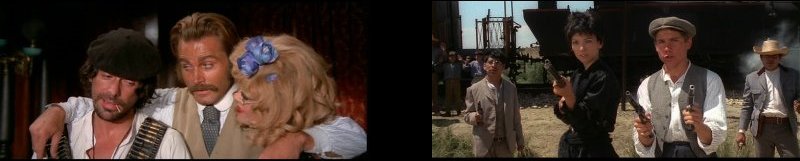
As with many of his best productions, Sergio Corbucci provides the script himself for Companeros and it is probably the most openly left-wing of all his productions, packed full of symbolism. Like most of the political Spaghetti Westerns it concerns the conflict between different groups of rebels during the Mexican revolution, equating to similar attitudes in Italy at the time – in this case the violent types who seem to be only in it for their own good and the student groups who genuinely believe in what they are fighting for and try to stick to peaceful means. He also manages to work in topic of American oil rights - the idea that the US Government would be prepared to kill to retain these rights seems incredibly contemporary.
Fortunately, Cobucci does not let the script become bogged down in symbolism and politics and the Western story stands up perfectly well on its own. A ‘buddy picture’ of sorts it avoids many of the genre cliches - Vasco is a lowly peasant and is shown up in a few scenes for being simple, he completely fails to grasp roulette, but he never appears 'stupid'. Peterson does suffer the 'thinking four moves ahead, and always correct' syndrome on a few occasions and his complex plans often seem to work, but he still needs help to survive some of the time, indeed one of the most ingenious plans later on in the film comes courtesy of Vasco. Despite the complex looking synopsis the film is never hard to follow and its 120 minute runtime rarely drags aided by the strong vein of comedy that runs throughout – although this is in tone with the film rather than the self-referential comedy of later genre entries. There are only a couple of large gunfights and these are usually not gratuitous but essential to the plot - although the speed at which Peterson is able to find a heavy machine gun during these does seem overly convenient.
Although Corbucci's best two productions (Django (1966) and The Great Silence (1969)) used very narrow framing, he opens up here to a full scope widescreen frame and shows a good mastery of this look as well - the quick fire shots in the gunfights and the classic 'brim of the hat' looks are all present and correct. The big Spanish landscapes look great and the sets all look genuinely south-of-the-border. An Ennio Morricone score provides decent incidental music and a catchy, lively theme song.
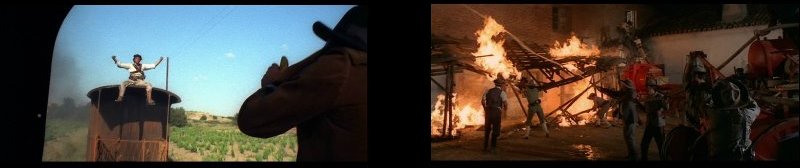
Tomas Milian and Franco Nero look great in their roles. Nero manages to pull off his usual 'under the brow of a hat' look, even in a straw hat while Milian is always perfectly cast as a scrawny peasant. Jack Palance brings a suitably mad atmosphere to his character and his equipé look suitably eccentric – their black suits make them look more like mafia than Wild West. Iris Berben is stunningly beautiful as the young female leader of Xantos' revolution while Xantos himself is played with a good scholarly dignity by Fernando Rey. Watch out for a brief appearance of Edoardo Fajardo (Django's Major Jackson) as the Colonel killed at the beginning and José Bódalo (Django's General Hugo Rodriguez) as General Mongo.
An ardent political viewpoint often makes for a fascinating Spaghetti Western and Companeros manages to balance politics with storyline more effectively than any other. Some solid direction and a trio of great performances make this a completely enjoyable experience and it comes recommended to fans of the Spaghetti Western, Sergio Corbucci or any of the lead cast.
| Anyone famous in it? |
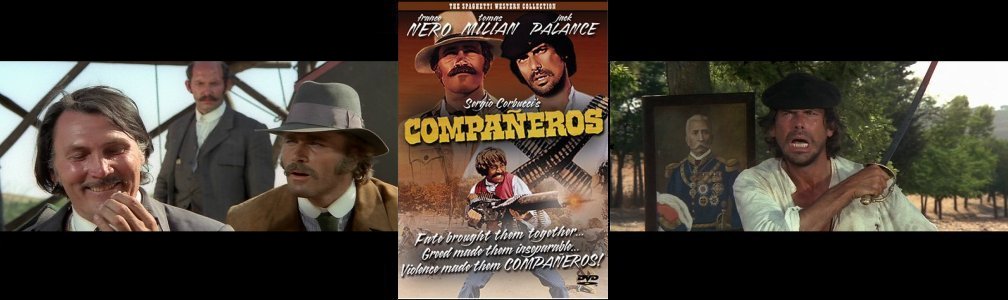
Franco Nero - Western star who made his name 1966 with Django and Texas Addio and Massacre Time Tomas Milian - Genre star from Django, Kill (1967) to Run, Man, Run (1968) and Four of the Apocalypse (1975) Jack Palance - Oscar winner for City Slickers (1991) he played Dracula in Dan Curtis Dracula (1973) |
| Directed by anyone interesting? | Sergio Corbucci - Italio-Western director, his oeuvre including the impressive Django (1966), Hellbenders (1967), The Mercenary (1968) and The Great Silence (1969) |
| Any gore or violence ? | Quite a lot of gunfights, often including machine guns, lots of blood. |
| Any sex or nudity? | Some suggestive scenes and dialogue but nothing more. |
| Who is it for? | Fans of Spaghetti Westerns should certainly track this one down, as well as fans or Corbucci and the lead cast |
| Visuals | Original Aspect Ratio - 2.35:1. Anamorphically Enhanced. Colour. The image is good with strong colour and detail and only a little grain and some scratches and speckles . |
| Audio | Italian and English language - Dolby digital mono. Both sound good. (Note: Some short scenes are in Italian only) |
| Subtitles | English for whole film, based on Italian track. English for sequences on the English audio track that are in Italian. |
| Extras | This disc includes:
|
| Region | Region 0 (ALL) - NTSC |
| Availability | Available on its own or as part of the Once Upon a Time in Italy boxset. |
| Other regions? | Region 2 Japan. Lower quality print, although some different extra features. |
| Cuts? | The film is believed to be fully uncut as per the original Italian cinema print. Titles and credits are in English. |