Text from this review not to be used without authorization.
Please contact:


Bidding fairwell to his comrade Argonauts, Hercules (Steve Reeves) and his new wife Iola along with the young Ulysses head for the hero's home town of Thebes. On the way however they learn that the city is under threat of war. King Oedipus gave up his throne to his two sons, agreeing that they would alternate each year, but Eteocles has refused to ceed the throne and Polinices is prepared to make war to win it back with a vicious band of mercanaries. Hercules, not wanting to see his home city torn by conflict, offers to mediate between the pair and heads up to Thebes to talk with Eteocles. The latter sees sense, knowing that he could not defend the city against such a force, agrees to surrender and sends Hercules back with a peace treaty. On the way however Hercules drinks from a forbidden stream and loses his memory - along with Ulysses he is taken by soliders to the palace of Queen Omphale, who plans to keep the hero as a lover. Meanwhile, both brothers think that they have been betrayed and battle lines are drawn...
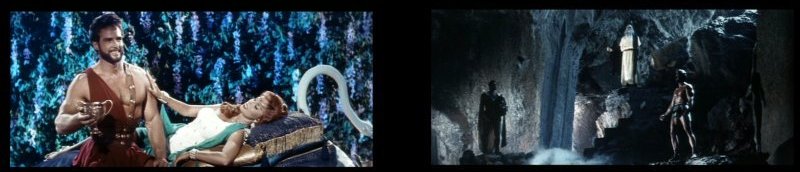
After a rather mysterious pre-credits sequence that will make sense much later, the film follows on directly from Hercules (1958) - with a voice-over recapping the characters and how they came to be there, as Hercules and Iola bid farewell to the Argonauts. While those who have seen the first film should enjoy this sequence, newcomers might find it rather dull and it relies on you knowing and enjoying the characters of the previous entry. Similarly to its predecessor, the film is noticably slow paced, especially compared to many of the follow-ups, with only a couple of fight scenes in the whole film and some scenes that do seem to serve as padding. Fortunately this slow pacing provides plenty of opportunity for storyline, and this film contains two.
It does at first seem like two rather unconnected stories have been combined into a single tale, although in the film as a whole they do seem to work quite well together. It is a pity that more focus is not put on the duelling brothers story, taken quite closely from a classic Greek legend known as Seven Against Thebes (although the savage 'seven' are curiously absent), which is notably more interesting and original than the Queen Omphale romance, which takes up most of the middle part of the film and does slow the pacing down considerably. This sequence is very loosely based on another Greek legend, Heracles and Omphale in which Hercules is forced to become the servant of the Queen for a year in punishment for murder - a rather more interesting story than that presented here.

Generally the film is a lot darker than Hercules, and at times borders on the surreal - the light hearted edge of many Pepla is missing here. Although Hercules is certainly not an anti-hero, the film does not seem to contain any typical villains - the brothers in particular are neither heros or villains, both with a good claim to their actions, while Queen Omphale never really aligns herself and we cannot be sure if she is evil or just mad. Eventually the film builds to a rather dramatic and quite tense battle scene climax although sadly this doesn't quite get nearly enough runtime to do it justice, running to less than four minutes. The whole concluding chapter of the film seems rather rushed - a shame since there are several scenes during the Queen Omphale sequence that could easily have been shortened.
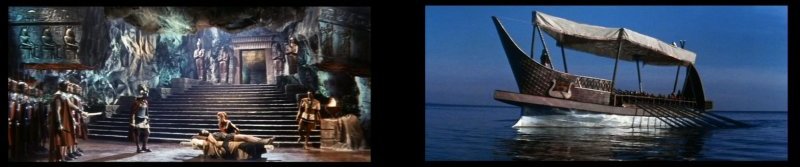
Director Pietro Francisci returns from the first film to helm the production but again it is the cinematographer Mario Bava whose presence here can really be felt, with the prudent use of matte paintings and the impressive lighting effects that lend the film his distinct atmosphere. The production as a whole is very impressive with some full size ships, beautiful sets and a good cast of extras, particularly in the final battle which would rank among the best in the genre if it had been given a little more time. The soundtrack by Enzo Masetti, who also worked on the first film, is quite typical and suits the film just fine.
Steve Reeves gets to do some good acting here as the baffled amnesiac Hercules and puts on a good show in the fight scenes as well. Sylva Koscina returns as Iole and is as beautiful as ever. Alongside the returning crew from Hercules there are a few recognisable faces in the cast including Sergio Fantoni (Von Ryan's Express (1965)) who gives a positively Shakespearian performance as Eteocles and the final film role for big heavyweight boxer Primo Carnera who has previously appeared as a strongman in The Mighty Joe Young (1948).
Despite some problems with the pacing, Hercules Unchained is a very enjoyable Peplum and ranks among the genre's best - blessed by good performances and some very fine work by Mario Bava the film looks superb and comes recommended to all genre fans. While okay for newcomers, it makes a lot more sense when watched alongside Hercules (1958).

| Anyone famous in it? | Steve Reeves - the iconic star of the Pepla, who also starred in Romulus and Remus (1961). |
| Directed by anyone interesting? | Pietro Francisci - a little known Italian director who helmed a couple more Pepla, including the original, Hercules (1958) and the pre-boom Peplum Atilla (1954) starring Anthony Quinn. |
| Who else was involved? | Cinematography on the film was by Mario Bava, soon to become famous for his horror films. |
| Any gore or violence ? | Nothing vivid. |
| Any sex or nudity? | None |
| Who is it for? | A very enjoyable Peplum and certainly recommended to all fans of the genre. |
| Visuals | Original Aspect Ratio - 2.35:1 anamorphic widescreen. Colour The print is very good for most of the film, with minimal damage and grain - although some scenes are notably lower in quality. |
| Audio | German and English tracks. Both sound good, although there are some audio drop-outs in the English. |
| Subtitles | None. |
| Extras | The disc includes some unrelated trailers. The DVD case includes a foldout poster for Hercules Unchained as well as a chapter insert. |
| Region | Region 2 (UK, Europe) - PAL |
| Availability | German release. DVD Box Title: Herkules Only available as part of a 2-disc pack with Hercules (1958) - the latter is sadly a cut and quite low quality print (see the review page for an image comparison). |
| Other regions? | Available on various public domain releases in the US with very low image quality and often fullscreen prints. |
| Cuts? | The print is missing a very brief (1 second) shot from the end of the film of bodies on fire - probably cut for the original German theatrical release. This cut is not noticable when watching the film. The print used is the English langauge print, with the German title overlayed. |